

Why is parenting so hard?
8 minute read
Check out my video on the same topic here: https://youtu.be/SIaAQyh2j6I
————————————————-
I talk to parents all the time who say that parenting is the hardest thing they have ever done. As a mom, I agree completely. As a therapist, I wanted to understand why. What is it about parenting that's so challenging? What makes it so exhausting, so stressful — especially when we also agree it's the most fulfilling thing we've ever done? How can something so fulfilling be so hard?
In this post, I want to walk through exactly why parenting can be so challenging, and hopefully offer some insight into how to make it a little easier.
The Practical Reasons Parenting Is Hard
There are plenty of practical reasons parenting is hard: finances, time, work schedules, space. There's a lot of moving pieces you logistically have to figure out to accommodate this extra person in your life, and that takes real cognitive resources — time, effort, and energy.
Of course, parenting is hard because you're doubling the central responsibilities of your life. You're not only responsible for taking care of yourself — getting yourself bathed, fed, entertained, educated, and rested — you're now responsible for doing all of that for a tiny child, too.
Parenting also comes with almost no breaks. It's very different from a standard job, where you're on call at every moment. You have to be ready to parent at 2 a.m. if your child throws up, wets the bed, or is hungry. You're up. There's no break, and very little control over your time.
Even if you have support — paid or unpaid, grandparents, a nanny — it's rarely a true break where all your responsibilities disappear. In most cases, people with extra help are just using that time for work, cleaning, cooking, errands, or their own doctor appointments — catching up on their own basic needs. I remember being postpartum and barely having time to shower. When I did get a break, it was just to wash my hair.
The Emotional Reasons Parenting Is Hard
On top of the practical challenges, there are emotional ones. Many parents go through a shift in identity when their children are born — they no longer feel like themselves, but like an appendage of someone else. Friendships and social circles shift too, especially if you're the first (or last) among your friends to have kids. You can't connect with friends the same way you once did.
Sometimes the hardest part of parenting is watching your child go through things completely out of your control but hurtful to them — whether that's your relationship with their other parent, or just life circumstances that you wish were different but can’t change.
Having a child also forces you to reflect on how you were raised. Whether that reflection brings appreciation for your parents and the sacrifices they made, or brushes up against old places of hurt, there's a lot of emotional history to navigate — on top of the everyday logistics of raising a child. It can bring up a lot of memories and feelings.
Someone once told me that parenting is like having your heart on the exterior of your body — you're far more aware of it all the time. Your emotions are more intense, and you're more vulnerable to being hurt. The emotional experience of becoming a parent is intensified in both directions, the good and the bad, and navigating that can be incredibly exhausting.
The High Stakes and Cognitive Friction
Because parents want to do a good job, they feel real stakes in the decisions they make — and there's science behind that experience. Parents often tell me this is the biggest, most meaningful thing they've ever done, and they don't want to mess it up. They don't want to ruin their kid with a bad choice or a mistake.
Picture a chart with two axes: one is how important a decision is — how big the consequences are if you get it wrong — and the other is how new the situation is to you. The line graphed on this chart represents the level of cognitive friction you feel: how much mental energy you have to spend navigating the experience. High cognitive friction brings high stress and high anxiety.
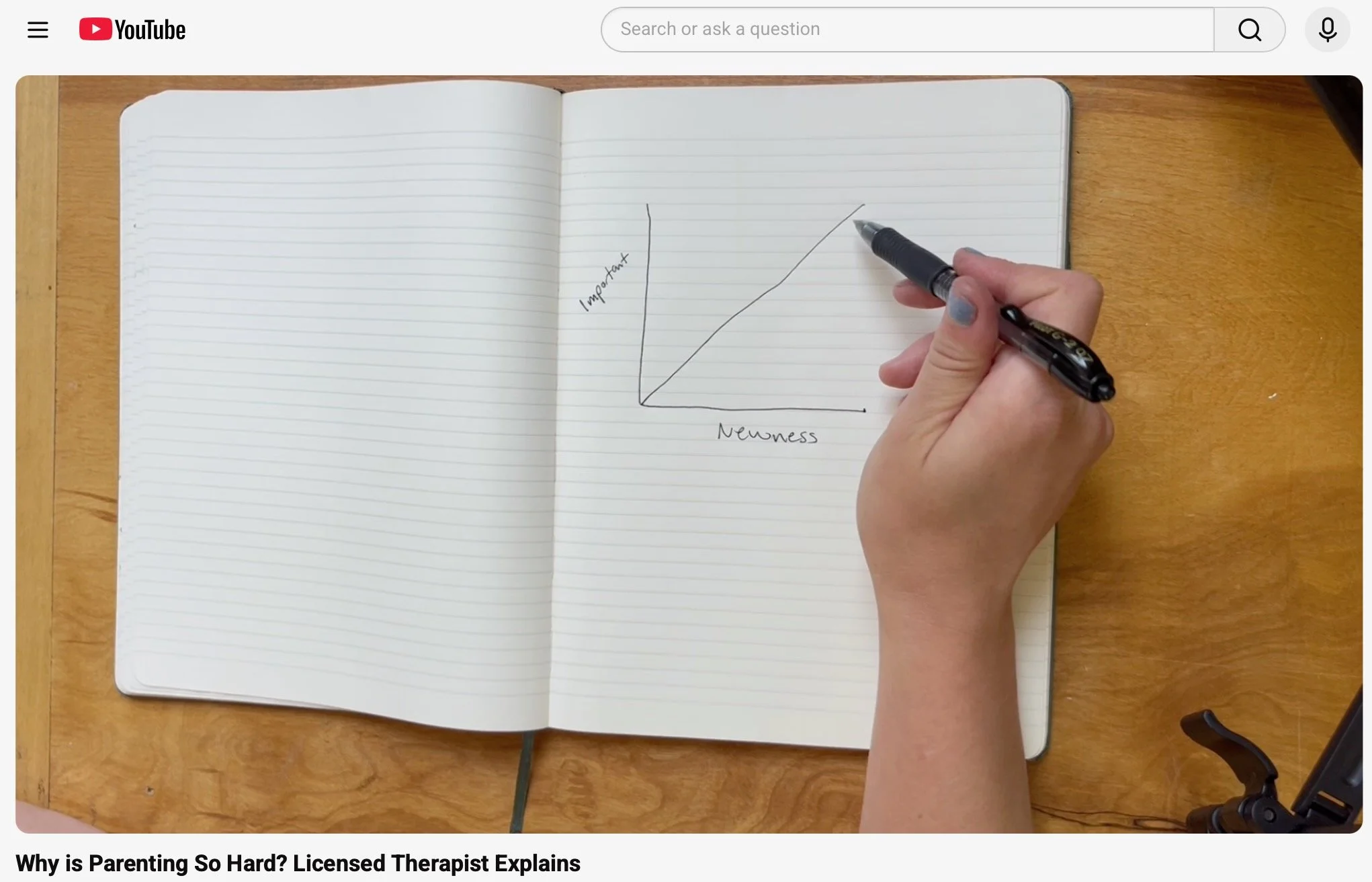
I explain more in the video! Click to watch.
Here's an example. Imagine a typical grocery trip — getting your staples at a store you've been to a hundred times. It's easy. You know what you're grabbing, where it is, and roughly how much you need. You don't have to think about it; your brain can go on autopilot.
Now imagine you wake up one morning with a new dairy allergy you've never had before. Suddenly grocery shopping is completely unfamiliar. You have to read every ingredient label, google whether products are made in a shared facility, plan new recipes from scratch. It's cognitively taxing, and the stakes are high — if you get it wrong, you could have a reaction.
When things are new, they're harder. When things are important, they’re harder. We feel more stressed about them.
Why the Newborn Stage Feels So Overwhelming
Nothing in my life has been more new and more important than bringing my daughter home from the hospital. In that newborn stage, I had never swaddled a baby, never changed a diaper — and those are the simple things. I had never put a baby to sleep next to me and worried about whether she'd be okay. I'd never made a bottle, never breastfed. Everything was new, even the simple stuff. So many parents go through that exact experience: you bring home this perfect, pure baby, and you just want to get it right. You don't want to do anything to tarnish something so wonderful.
To make things harder, every decision in that newborn phase is cluttered with other people's opinions. It's difficult to know what you actually think, feel, or believe is right when you're being told five different things. Everyone has an opinion about parenting, and they're rarely the same, which makes it hard to know what's true or what you genuinely feel good about.
One corner of the internet will tell you that co-sleeping with your toddler causes lifelong sleep issues and that kids need to be trained to sleep alone. Another corner will tell you sleep training is cruel and will cause a whole different set of problems. There's so much conflicting information out there, because not everyone shares the same opinion on parenting — and that makes it incredibly hard to navigate all this newness and high stakes, because it feels like no matter what you do, you'll get it wrong.
It's Okay That Parenting Is Hard
That combination — high stakes and constant newness — makes parenting inevitably hard. It causes real stress and anxiety because we're figuring it all out for the first time. And I want you to know that's okay. I'm not saying it's fun, or that stress feels good. But there's nothing wrong with you if parenting is hard. In fact, if it's hard for you, that tells me two things: you love your kids, and you want to do a good job. That's what being a parent is. Knowing that doesn't necessarily make parenting easier, but it can at least ease the worry that you're doing something wrong. You're not.
Finding Your Values Instead of Chasing Perfection
After having my daughter, I went through so much stress and self-doubt trying to be perfect. Eventually, I treated myself like I would a client and asked: how can I make this easier? How can I become more confident instead of questioning every decision? The answer, pulled from both research and my clinical experience as a therapist, was values — figuring out what's actually important to me.
We all say it's impossible to be a perfect parent, but do we really believe that? When I had my daughter, I genuinely thought I could do the right thing 100% of the time, if I just tried hard enough. But when "the right thing" is defined by other people, you'll never feel like you're getting it right — because what looks right from one angle looks completely wrong from another. When other people define good parenting for you, you'll never feel like it's enough.
Once you realize everyone will tell you something different, because everyone is different, there's freedom in that — you get to decide for yourself what it means to be a good parent. There's no single way to be a perfect parent, but there are hundreds of ways to be a good one. What's yours?
Once you've worked that out, the goal isn't to "get it right" anymore — it's to act in ways that align with the parent you want to be. Setting your own goal line makes it far easier to meet it, and far more intuitive to make progress toward becoming that parent, rather than someone else's version of one. When decisions come up, you can make them from a place of stability and confidence, because you know the parent you're aiming to be, and you can ask: what brings me closer to that?
Nothing will make parenting less new or less unfamiliar — you can't do the second bath without the first. But if you keep returning to your own internal compass — what's right, what feels good to me — the process of decision-making becomes far more comfortable and familiar, even though each situation itself is still new. The way you approach the decision becomes familiar, even when the decision isn't.
Values also have the advantage of being stable. What matters to you now will likely still matter to you a year from now, and probably mattered to you a year ago too. Values don't shift much, which gives you a sense of constancy amid all this change.
That practice comes with an added bonus: getting to know yourself better. In that process, you'll feel more confident, experience less self-doubt, and regret fewer decisions — because you'll know they came from a place of thoughtful intention about what matters to you.
Closing Thoughts
Parenting is hard, and that's okay. I hope this gives you more clarity on why it's hard, and makes you feel a little less alone in that experience — because difficulty is simply a natural part of parenting. Even though it's uncomfortable for me to share this, I know there are parents out there who've felt exactly what I did: doubting themselves at every turn, feeling like they had to be perfect, finding the newborn stage exhausting and taxing. I want to normalize that experience, and offer some insight into why it happens — so you can focus on what you actually have control over: how you approach decisions, and your method of decision-making.
To that end, I've put together a free value identification guide. Helping parents feel more confident — and know that they can't be perfect, but they can be themselves — is something I really care about.
You can access yours here for free: https://www.aparentlikeyou.com/your-values
Take your time with it. Get to know your values, and what's important to you, so you can become a parent who makes decisions from a place of clarity and confidence.
Because if there's one thing I want you to know, it's this: there's no better parent than a parent like you.
